Discrete manufacturing · Shop-floor Android app
Manufacturing warehouse app
Production jobs, machine quantities and package verification on a handheld, built on an inherited Ant Design implementation. She extended the job screens and tightened how status is read.
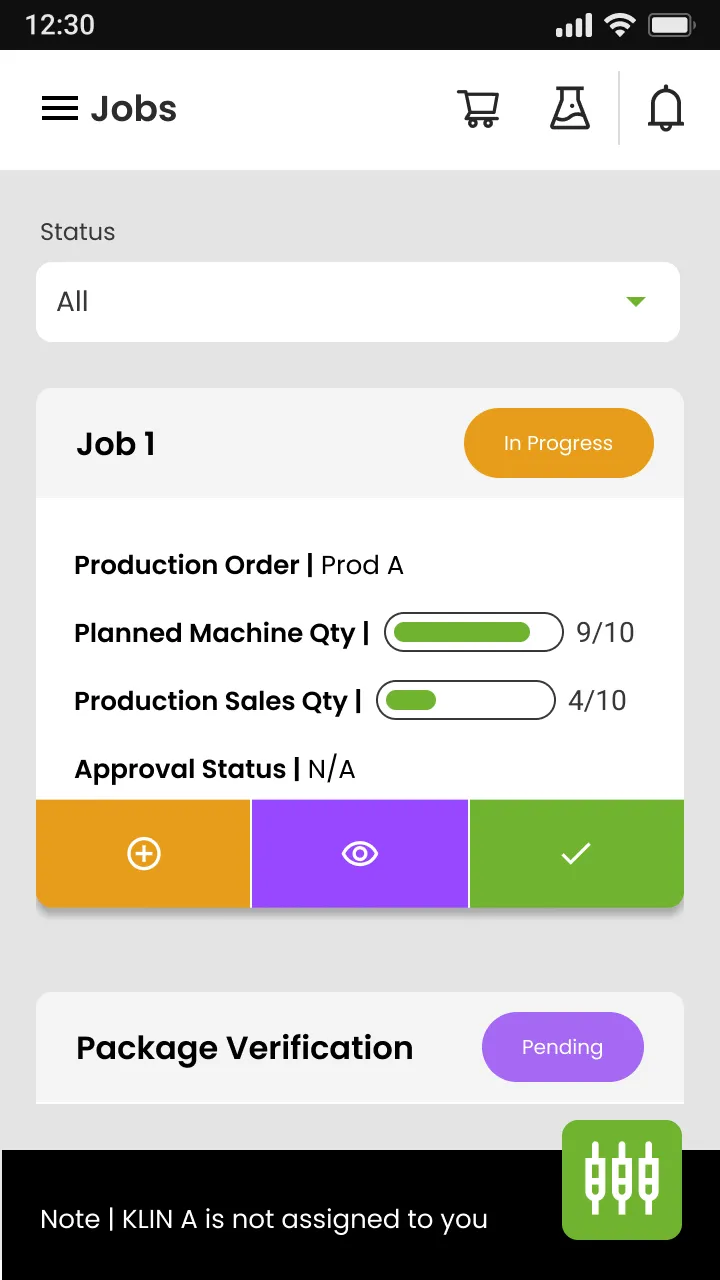
- Quantity as a bar
- Planned against produced reads as a filled track with the pair of numbers beside it, so a job is judged without arithmetic.
- Actions on the card
- Add, inspect and approve sit on the job they belong to, full width and thumb-sized, rather than in a menu.
- Assignment notice
- The reason an operator cannot proceed is stated in words at the foot of the screen, not as a disabled control.
Constraint
A palette she did not choose.
Status colour was already in production across other modules and could not be renamed mid-release. The work was to make it consistent and to stop it carrying meaning on its own.
What changed
Every state also says its name.
Chips label the status they tint, progress is shown as a value as well as a fill, and each action carries an icon with a fixed meaning across modules. Type and target sizes were raised for a device held at arm's length in a noisy room.